

Insights from the front lines of human-centred design.
Research, reflections, and knowledge sharing. Sometimes observational. Sometimes provocative.
Not always polished. Always tied to the real world, and always honest.

Auckland Hospital: Wayfinding isn’t accidental. It needs ownership.
At a busy campus, whether a hospital, airport, or university, people seek a service. Yet many campuses struggle to provide a coherent experience from entry to destination. Despite a shared sense of frustration, the root problem often goes unaddressed. Local fixes, like laminated signs, pop up as symptoms of a deeper service issue, where individual departments lack the remit or capability to take ownership of the full journey. Campuses are typically divided into spheres of accountability: a...

Enhancing Wayfinding Experiences in Hospitals Worldwide: Beautiful Functionality in Action
Hospitals are environments of immense emotional and physical intensity. Navigating these spaces can be a daunting experience, particularly for patients, visitors, and even staff. At Humanics, we understand that wayfinding is not just about signage; it is about creating a seamless and intuitive journey that reduces stress and improves the overall experience for everyone involved. Our mission is to enhance wayfinding experiences in hospitals worldwide, making them more navigable, user-friendly,...

Service Design and User Experience: Spot the difference
User experience (UX) and service design often get used interchangeably. But they focus on different layers of the same challenge. Understanding the difference isn’t about labels, it helps projects land better outcomes and avoid costly gaps. User experience focuses on the moment. Service design connects the system. UX looks closely at how someone experiences a single point in time: reading a sign, asking a staff member, finding their way, or using a service. It’s about making those moments...

Carparks as Experience Touchpoints: Improving Navigation, Safety & Wayfinding
They’re where the experience begins and ends, but carparks are often overlooked. Treated as a practical necessity, not part of the designed experience. When that happens, people arrive frustrated, leave disoriented, and the space in between doesn’t stand a chance. The carpark is part of the journey People don’t arrive at your building. They arrive at your carpark. Navigation starts the moment they approach the site, well before they walk through the front door. If that first step causes...

This is Michel
Michèl Verheem – Finding My Direction by Questioning Theirs I get lost easily. That might sound strange coming from someone who built a career around wayfinding, but for me, it’s actually an advantage. It means I can step into the shoes of the people who need our support the most. The people who are confused, overwhelmed, in a rush, in pain. I’ve been there. I am there, often. That lived experience has shaped everything I do. I started out in a signage company in the Netherlands in the 1980s....

My Lego Bike and Wayfinding Design: What They Have in Common
There are 603 parts in the LEGO model of my BMW Adventure motorbike. I know this because I've spent many wonderful hours constructing it. This miniature version of the bike type I actually ride, my full-size BMW R1250 GSA, isn’t just a toy. It’s a perfect reminder of what happens when every element is considered, tested, and designed to work together. The pistons move. The suspension flexes. Even the handlebars are made from 38 individual parts, each one contributing to a system that works....

Designing for Wayfinding, Not for Signs
Why architecture is the first wayfinding tool We have a bit of a love-hate relationship with architects. Not the people, most are brilliant. But when it comes to designing for movement, we often see the world a little differently. Architects deal with structure. With the beautiful chaos of column grids, air ducts, service trays, and regulatory compliance. Their world is concrete, steel, and light. Ours is perception, cognition, and behaviour. We look at a space and see decisions, detours, and...

My fascination with # StupidSigns
Why Bad Information Hurts Good Places I’ve spent the past years collecting stupid signs. Not for laughs (though some are hilarious). But because they say something serious about how we design, manage, and experience public environments. We’ve all seen them. The taped-up A4 printed in Word. The laminated instructions stuck to the lift. The ten signs screaming from one pole. The permanent 'temporary' note that’s been there since 2019. Stupid signs aren’t just bad communication. They’re symptoms...

The Blue Plastic Urn Doesn’t Fit
A woman arrives at the cemetery reception with a shoebox in her hands. English is not her first language. The box holds the remains of her stillborn child. She is asking, not demanding: can we hold this? Can there be a ceremony? The receptionist hesitates. Computer says no. That’s not a service we offer. Later, in the back room of the crematorium, I follow Sean, the crematorium operator. Caring. Gentle. Tired. He shows me the storage room where the uncollected ashes wait. It’s surprisingly...

Clearer paths, calmer passengers: the science of airport wayfinding
Airports are stressful. That’s not an opinion-it’s science. Research consistently shows that unfamiliar environments, time pressure, and lack of control are top contributors to passenger stress in transport hubs (Cohen et al., 2007; Correia et al., 2017). And in the airport context, all three often come together in one place: the terminal. But what makes an airport feel manageable-or overwhelming? The answer, often, is wayfinding. It's about the experience People tend to associate wayfinding...

Is Literacy the Overlooked Barrier to Hospital Accessibility?
When hospitals address accessibility, the focus often centres on physical features like ramps, lifts, or hearing loops. But there’s another barrier, less visible, more widespread, that quietly shapes how people experience care: literacy. And not just reading words. It’s about understanding instructions, navigating complex systems, and making sense of clinical information while under stress. Reading Doesn’t Guarantee Understanding An individual might read every word on a sign or letter and...

Inclusive Design Creates Better Experiences for Everyone
Inclusive design is about creating environments that work well for more people. It goes beyond accessibility checklists and starts with a basic principle: people are different. They move, think, see, hear, and process information in different ways. Good design respects that. When we talk about the user experience of a place, we’re talking about how it feels to be there. How easy it is to enter, move through, and find what you need. How much stress it causes, how confident it makes you feel,...

Mind the research gap: the limits of human-centred design
Human-centred design changed the way we think about services, spaces, and systems. It put people at the core of design decisions. But on its own, it’s not enough. Without strong research, broad participation, and a systemic lens, it can end up reinforcing the very issues it aims to address. When ‘human’ doesn’t mean everyone Human-centred design often focuses on people who are easy to reach; those who are available, confident, and already involved. It overlooks people with limited time,...

Inclusive Design vs Universal Design: What’s the Difference?
Inclusive Design and Universal Design both aim to create environments that work for as many people as possible. But they approach the challenge from slightly different angles. Universal Design is about creating one solution that works for everyone, as far as possible, without the need for adaptation. The term originated in architecture and product design, and was later formalised in principles developed by Ron Mace and the Center for Universal Design in the 1990s. Think of ramps that blend...

Inclusive Travel Design Shapes Seamless Passenger Journeys
Wayfinding is often described as the process of moving from one point to another, broken down into a series of decisions. But its impact goes far beyond that. How people find their way influences their confidence, comfort, experience, and even the operational and financial success of a place. When wayfinding is overlooked, inclusivity suffers, and so does everyone’s ability to use the space well. When navigating somewhere unfamiliar, our minds are often racing: “Should I go left or right?”...

Integrated Space Design: Aligning UX, Wayfinding & Built Environments
When designing a space, it’s crucial to view it from multiple perspectives to ensure it meets the needs of all users. However, it’s equally important that these perspectives are not considered in isolation. Instead, they should be integrated and balanced through collaborative efforts, bringing together environmental psychology (EP), wayfinding strategy, user experience (UX), and inclusive design. Environmental psychology provides insights into how people interact with spaces and how different...
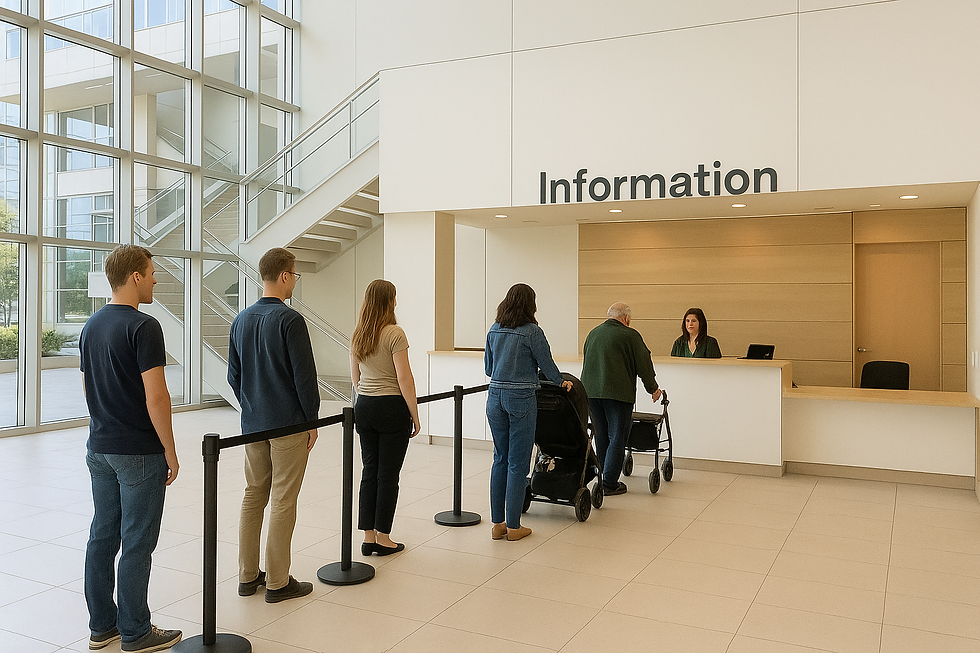
Why we use Environmental Psychology at Humanics Collective
Because shaping environments works better with evidence. When we work on a hospital, a transport hub, or a civic precinct, there’s no room for assumptions or personal taste. What worked somewhere else won’t necessarily work here. To get it right, we need to understand how people actually behave in a space, and why. That’s where environmental psychology comes in. It’s the science of how environments influence human behaviour, perception, and decision-making. We use it to ground our...

The myth of shared zones: Rethinking Urban Design for Inclusive Public Spaces
Shared zones are meant to support more inclusive streets. But the idea that we can simply remove boundaries between pedestrians and cars and expect people to “negotiate” doesn’t always hold up in practice. Where the idea came from The concept of shared space traces back to Dutch traffic engineer Hans Monderman. His work in the late 20th century challenged the idea that more signs and stricter rules automatically led to safer streets. In his view, fewer controls made people more attentive,...
- Page 2